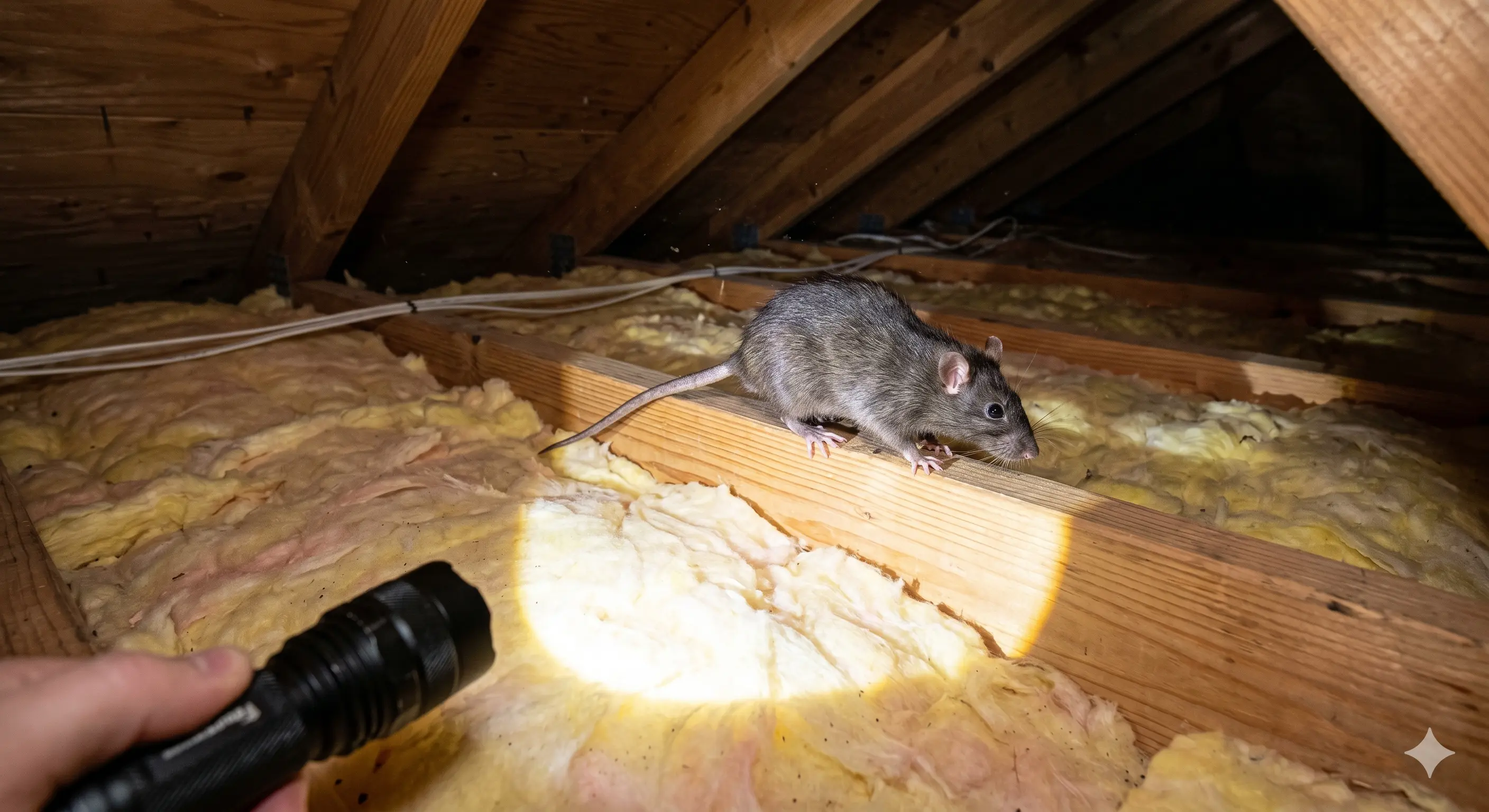
The phrase Eugene homeowners almost always start with is, "I think I have rats in the attic." Roughly 80% of the time, they're correct. And roughly 90% of the time, the rat in the attic is Rattus rattus, the black rat, or roof rat. The other species we deal with in the area, the Norway rat (Rattus norvegicus), is a ground-level animal that prefers crawl spaces, garages, and the gap under the utility room door.
The distinction matters a lot. Roof rats are climbers, so their entry points are at the roofline. Norway rats are burrowers, so their entry points are at grade. Treating one like the other wastes time and money.
Identifying Which Rat You Have
The species call shapes the entire treatment plan, so we always confirm before setting traps. A roof rat infestation in a 1920s Friendly Area bungalow gets handled very differently than a Norway rat colony under a 1985 Cal Young split-level.
Roof Rats (Rattus rattus)
- Where they're heard: Ceiling cavities, second-story walls, and soffit areas. Scratching is typically between 10 p.m. and 4 a.m.
- How they got in: Roof-soffit junctions, gable vents, plumbing stack flashing, and tree branches touching the roofline. Roof rats are remarkable climbers. They travel utility lines, fence tops, and tree branches with ease, and can squeeze through openings as small as half an inch.
- Droppings: 12–13 mm, pointed at both ends, scattered along attic runways.
- Eugene-specific note: Strongly associated with mature fig, plum, and apple trees in older Eugene yards. They also follow ivy and Himalayan blackberry straight up exterior walls.
Norway Rats (Rattus norvegicus)
- Where they're heard: Underneath the house, in the laundry room, behind kitchen base cabinets. Often a heavier drag-and-thump than a roof rat.
- How they got in: Missing or rusted foundation vents, gaps under exterior doors, broken sewer laterals, deteriorated crawl space access hatches. Norway rats are powerful diggers that excavate burrows 2–3 inches wide extending up to 6 feet underground.
- Droppings: 18–20 mm, blunt-ended, concentrated in burrow runs and along foundation walls.
- Eugene-specific note: Common along the Willamette and Amazon Creek corridors, in River Road and Whiteaker, and on properties with backyard composting or chicken coops.
A useful behavioral clue: Norway rats typically stay within 100–150 feet of their nest, so their activity tends to be concentrated. Roof rats range farther for food, which is part of why they're so commonly the species found in attics across older Eugene neighborhoods.
The Exclusion-First Protocol
Setting traps without sealing entry points is the most common mistake homeowners and cheaper pest control outfits make. New rats from the surrounding population will fill the vacated territory within days, and the problem isn't solved.
A proper Eugene operator does exclusion before traps go down, with one rare exception: a single, clearly transient animal where evidence of broader infestation is absent.
- Full attic and crawl space inspection. We crawl the entire envelope of the home, photograph every grease mark, gnaw mark, and droppings cluster, and map every entry point on a printed elevation sketch. Nothing goes to memory.
- Exterior seal. Heavy-gauge galvanized hardware cloth (we use 22-gauge, with 1/2-inch mesh) goes over foundation vents, gable vents, dryer vents, and roof penetrations. Plumbing pipes are wrapped in copper mesh and bedded in elastomeric sealant. We never use spray foam on its own; rats chew through it without resistance. Hardware cloth is the industry standard for a reason: rodents simply can't gnaw through it.
- Trap deployment. Mechanical snap traps placed inside tamper-resistant boxes, positioned along confirmed runways inside the structure. A typical setup is 8–24 traps depending on home size and infestation severity.
- Service visits. We return on a 5–10 day cadence to reset traps, remove carcasses, and re-evaluate. Most jobs close out within 3–5 service visits.
- Sanitation. Soiled insulation is removed and replaced. Surfaces are fogged with a hospital-grade botanical antimicrobial.
Why Reputable Operators Don't Use Rodenticide in the Attic
This is the question Eugene homeowners ask most often, so it's worth explaining clearly. Reputable Lane County operators avoid rat poison in attic or wall-cavity applications, and here's why:
A rat that ingests an anticoagulant rodenticide doesn't die immediately. Clinical signs typically don't appear for 3–5 days after a toxic dose, and the animal almost always dies somewhere inaccessible: inside a wall cavity, under floor decking, or in a soffit return.2 The carcass odor that follows lasts three to six weeks in a warm attic.
There's a second problem that gets less attention: ectoparasites. Fleas and mites leave a cooling rodent body in search of a new host. In a residential attic, that host becomes you, your dog, or your kids. Professional rodent product literature acknowledges this so directly that some rodenticides are formulated in combination with insecticides specifically to keep parasites from relocating off the dying host.4
Then there's the secondary poisoning issue. Pets, owls, hawks, and neighborhood cats can be poisoned by eating a dying rat, and anticoagulant residues can stay in liver tissue for weeks.3 Mechanical trapping is slower on paper, but it's cleaner in every other dimension and produces no carcasses you can't retrieve.
The Eugene Rainy-Season Pattern
Most of our annual rat work happens between mid-September and late January, and the pattern is remarkably consistent. The first week of sustained rain pushes rats off pasture, blackberry thickets, and woodpiles toward heated structures. By the third week of rain, we're typically booked out two weeks.
This isn't unique to Eugene. It's the standard rodent pattern across the Pacific Northwest, where mild, moist winters allow rats to remain active rather than slow down. Researchers have documented sustained increases in Oregon rodent populations over recent years, and Lane County is no exception.
Practical takeaway: If you've had rat problems in previous winters, schedule your inspection in August or early September. Calling us in November means waiting two weeks while rats keep moving in.
Pricing and Warranty
Most Eugene operators offer free inspections. A typical exclusion-and-trapping program in Lane County runs $1,400–$3,800, depending on home size, infestation severity, and how much of the building envelope needs new hardware cloth. Crawl space cleanup is priced separately.
A reputable operator will offer a two-year written warranty on every excluded entry point: if rodents return through a sealed point during the warranty window, the operator re-treats at no cost.
What's Included as Standard
- Two-person crew, fully PPE-equipped
- 22-gauge galvanized hardware cloth on all vents and penetrations1
- Up to 24 mechanical snap traps in tamper-resistant boxes
- 3–5 service visits over 2–6 weeks
- Final inspection report with photo documentation
- Two-year written exclusion warranty
Related Services
After the rats are gone, most attic and crawl space areas need cleanup. Soiled insulation is unsalvageable, and the longer it sits, the more ammonia it offgasses into the living space below. See the crawl space & attic restoration service for what restoration involves, and the structural exclusion service for sealing the building so the rats can't return.
Citations
-
National Park Service. Rodent Exclusion Manual: Mechanical Rodent-Proofing Techniques (2019). Authoritative federal guidance on hardware cloth gauge specifications and exclusion methodology used throughout the pest management industry.
nps.gov -
Pennsylvania Game Commission. Rodenticide Toxicity. Documents the 3–5 day clinical onset of anticoagulant rodenticide toxicity and the secondary-poisoning risk to non-target wildlife and pets.
pa.gov -
National Pesticide Information Center (Oregon State University). Rodenticides Fact Sheet. Peer-reviewed reference on rodenticide residues in tissue, secondary poisoning pathways, and persistence in predator livers.
npic.orst.edu -
ScienceDirect. Rodenticide overview. Confirms that rodenticides are sometimes formulated with insecticides specifically to prevent ectoparasites (fleas, mites) from leaving the dying rodent host.
sciencedirect.com -
eXtension Wildlife Damage Management. Rodent Exclusion Methods. Industry-standard reference on materials, gauge specifications, and mesh sizing for rodent-proofing residential structures.
wildlife-damage-management.extension.org