
A mouse can squeeze through a hole the diameter of a #2 pencil. That single fact explains why Eugene's mouse problem is genuinely seasonal, genuinely predictable, and almost entirely a function of how well the house was sealed before the first hard rain. The two species we encounter — the house mouse (Mus musculus) and the deer mouse (Peromyscus maniculatus) — behave differently and call for different programs, but the exclusion playbook is broadly the same.
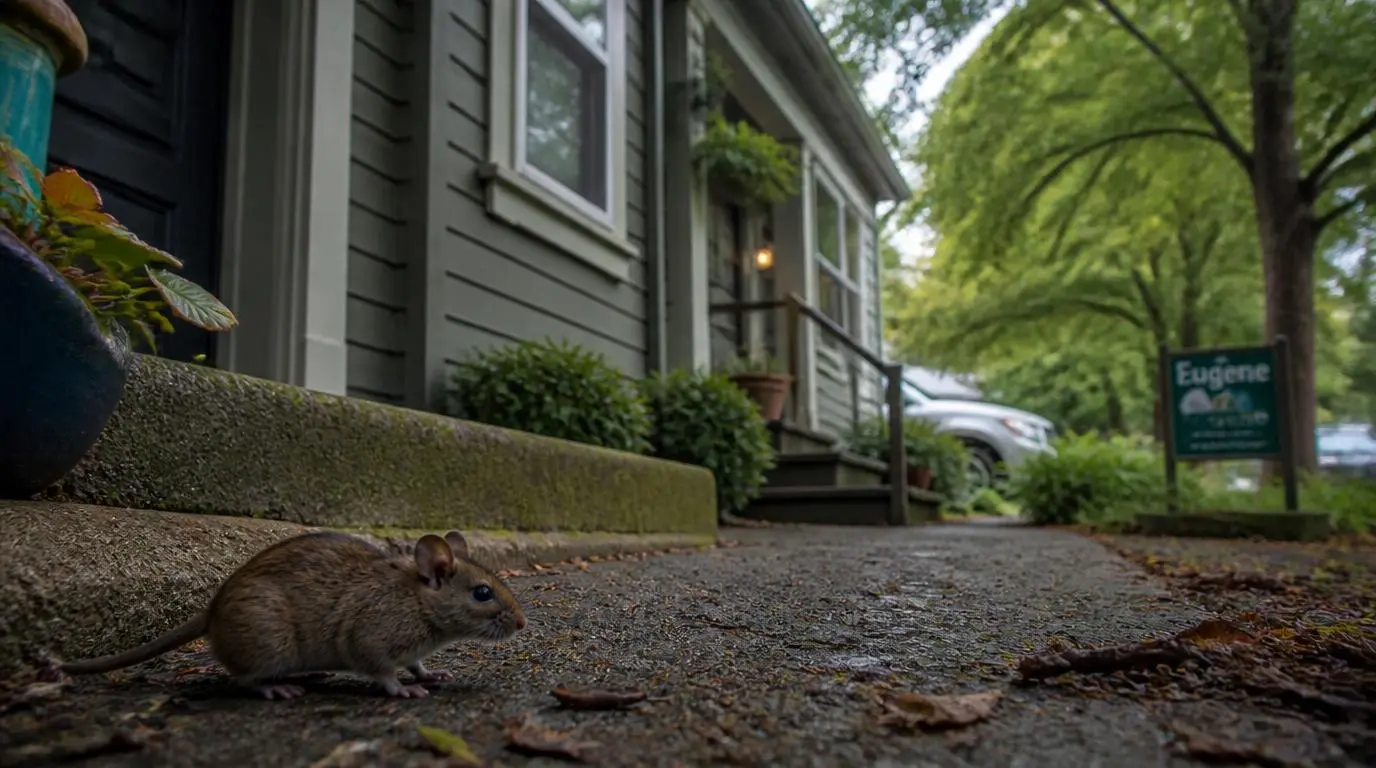
The two species you'll actually see
House mouse (Mus musculus)
The classic urban pantry mouse. Gray-brown above, tail roughly the length of the body, lives in close commensal contact with people. House mice are the ones in your silverware drawer, the ones leaving droppings on top of the dishwasher, the ones living in the bottom of the gas range. They tolerate human activity, breed every 25 days, and a single pregnant female colonizing an attic in October produces an established 30+ animal infestation by February.
Deer mouse (Peromyscus maniculatus)
White-bellied, large-eyed, much more skittish. Common in Eugene homes that back up to forest, greenway, or open field. Deer mice are the species of concern for hantavirus — rare but documented in Lane County. We treat any deer mouse cleanup with full PPE and wet-method sanitation, never sweeping or vacuuming dry droppings.
Why mouse problems start in October in Eugene
The Willamette Valley has a remarkably consistent rodent-movement calendar. The first sustained rain (typically the first or second week of October) saturates the pasture and forest litter where mice have been nesting all summer. Within 10 days, ambient temperatures drop into the 40s overnight. Mice move toward thermal mass — your foundation, your slab, your heated crawl space. The first scratching in the wall is almost always the third week of October. By Thanksgiving, the colony is established.
If you've had mouse problems in past winters, the right time to call us is August or early September — before the colony has a chance to establish. Exclusion done in dry weather is faster, cheaper, and more thorough than work done in November rain.
Where mice get in to a Eugene home
Across thousands of Lane County inspections, the entry points are remarkably consistent across housing eras:
- Garage-to-house door undercut. The single most common entry. The 1/2 to 1 inch gap under the door from garage to laundry/mudroom passes a mouse easily.
- Sill plate to foundation gap. Older Eugene homes (pre-1970) often have a noticeable irregular gap where the wood sill meets concrete or block foundation. Mice walk in.
- Dryer vent stubs. Plastic exterior dryer flaps fail open or get held open by lint. Easy entry behind the dryer.
- Plumbing & HVAC penetrations. Every pipe that exits the building has a gap around it. Without copper mesh and sealant, every one is an entry.
- Foundation vents. Original 1950s–1970s foundation vents are rusted, broken, or missing the screen entirely on a startling number of Eugene crawl spaces.
- Door weatherstripping. Worn or compressed weatherstrip on exterior doors. Mice find the gap at the corner of the threshold.
How a good operator eliminates the population
A proper mouse protocol uses the same exclusion-first approach as rat work, tuned for the much smaller body size and much larger population numbers.
- Inspection. Whole-envelope walk-down with documentation of every entry point under 9 mm. Pantry, range, dishwasher, and dryer pulled out and inspected. Crawl space and attic checked for active runways.
- Structural exclusion. Steel mesh, copper wool, and elastomeric sealant on every documented entry. Door sweeps installed on garage-to-house door if needed. Foundation vent screens repaired or replaced.
- Interior trapping. Mechanical snap traps in service boxes placed along confirmed runways. Typical 18–40 trap deployment for a single-family home.
- Sanitation. Droppings vacuumed under HEPA with wet-method pre-treatment for deer mouse work. Affected pantry contents bagged and disposed.
- Final monitoring. Two follow-up visits at 10 and 21 days to confirm zero activity before closing the job.
On the question of poison. First-generation rodenticides (the ones legal for residential interior use) are slow, single-feeding ineffective, and leave mice to die in wall cavities where the carcass odor is a six-week problem. The reputable operators in the network avoid them inside structures. If you've been using over-the-counter bait blocks and the problem isn't getting better, that's why.
Mouse work in older Eugene neighborhoods
Three Eugene neighborhoods produce more mouse calls than the rest of the city combined: the Friendly Area (pre-war housing stock with irregular sill plates), Bethel and Trainsong (mid-century construction with original foundation vents intact and rusting), and the rural fringes near River Road, Santa Clara, and Coburg (deer mouse pressure from adjacent pasture). Each calls for a slightly different exclusion plan. See the Eugene rodent guide for the neighborhood-by-neighborhood breakdown.
What it costs
A typical Eugene mouse exclusion-and-elimination program runs $850–$2,400 depending on home size and the number of entry points found. Inspections are always free. Two-year written exclusion warranty included as standard.